Fact is I have had a jolly good vacation while the world fell apart at the seams, or so it seems! Pun intended. My thoughts on what and why this has happened are unprintable.
I do have strong opinions about the post Thatcher and post Reagan changes in the financial sectors of both USA and the UK, that leveraged the property market. The fact is that these are war economies and so deserve special attention.
I do feel that the consumer price index should include rent on land and appreciation of land, after all, is not that what communism was all about.
Now that the weaknesses of both systems have been revealed to revolve around the value of land, we can have a better idea of where to reconstruct both.
What is printable is that there are obvious solutions, even though these promise to be painful. What I see is a severe mathematical disjoint between incomes and debt. Normally economies meet this change by means of the price mechanism.
The problem with the needed price adjustment is that its effect would be to slow activity in areas where activity has been compressed within time just as the price rises of the past decade have compressed activity forward in time in certain areas such as housing and consumer capital items (such as, furniture, heating and decoration).
It seems obvious that what will happen is a reallocation of incomes coming from different areas and capital going into different areas from what we have seen.
The stock market and related economies will continue to grow but some sectors, formerly starved of investment will receive investment while other sectors that have received too much investment should receive less.
The oil sector is grossly over invested as is every item that uses oil, so this sector needs to be starved of capital while the solar sector needs to receive capital.

Scratches to Sketches
Showing posts with label economics. Show all posts
Showing posts with label economics. Show all posts
Monday, 26 January 2009
Friday, 5 September 2008
Creative Economies of scale
Climate Disequilibrium
and New Energy Resources
Our understanding of economic forces is still very limited
In most economics courses, one will be taught, whether directly or indirectly, that resources cannot be created. They can be discovered, but not created. The inability of an economy to create resources is an assumption that is worth thinking about. Is it wrong, or is there something mysterious about economics remaining to be discovered? Lets rephrase the issue a little. Mining can discover new resources for an economy, but these resources were always there. Researching people, the geologists, miners, and others find mineral and other resources within an economy, but these resources are already present within that economy.
Standard economics fails on the test of being logical
The creation of resources out of non-resources, in fact, happens all the time, but it is not within the standard economics framework. Hold on! The non-resources are already present in the economy, so they must be resources. Everything within an economy must be a resource if one is to be consistent. There does not exist a non-resource within an economy. Perhaps, but this is confusing?
Our problem with economics and economic analysis is that it is inconsistent in fundamental ways. It once was that economic thought followed the mistaken notion that equilibrium is brought about by market forces. Not so! In my view, market forces have very little to do with equilibrium. One is more likely to find disequilibrium arising from fundamentals of economics, and much of this has to do with the creation of resources within economies. The creation of resources is the much neglected force within economies misunderstood for the most part by economic theory, especially neoclassical theory.
The economic notion of free markets producing equilibrium is myth
Market forces enable exchange using money, but rarely enable a steady state of equilibrium, except as short run phenomena. The reason is because of new resources being discovered, used, or created within an economy, and new resources coming from outside the economy, both give the world an economic reality of disequilibrium, if only because of birth and death realities. The fact is that the greatest resource and economy contains are its individual people, and individual people are not a constant resource. The abilities of people are constantly being improved or weakened, waxing or waning because of learning, discovery and health. Most economic models do not capture the processes of human and technical resource creation and destruction going on all the time.
Energy resources must be made, created or discovered through advanced technology
Surprisingly the most advanced technology on earth is natural and consists of photosynthesis. Without photosynthesis we would be dead. There are economies of scale to be tapped using photosynthesis as the engine of energy creation and storage. This natural technology can save the earth from the disequilibrium produced by the bad economic theories of neoclassical economics, those theories that believe in steady state equilibrium and which are totally off the mark, just plain bad economics!
For a start, economies of scale predispose economies towards disequilibrium. No economic model with economies of scale will produce a lasting stable equilibrium. Its just not in the mathematics, and yet most technologies embody economies of scale and most profits of economies are due to economies of scale. The neoclassical economic theories that neglected this or ignored this produced bad results, gross misunderstanding and wasted everyone's time in cloud coocoo land.
A sensible economic of energy assumes that energy can be captured, created and stored with the benefit of economies of scale. These economies mean that there is more than enough potential for the earth to supply the energy needs of everyone to come. The problem with the dynamics of economies of scale are that it will lead to disequilibrium in the earth's climate. The economies of scale of energy creation and storage must, absolutely must, be understood and managed.
In most economics courses, one will be taught, whether directly or indirectly, that resources cannot be created. They can be discovered, but not created. The inability of an economy to create resources is an assumption that is worth thinking about. Is it wrong, or is there something mysterious about economics remaining to be discovered? Lets rephrase the issue a little. Mining can discover new resources for an economy, but these resources were always there. Researching people, the geologists, miners, and others find mineral and other resources within an economy, but these resources are already present within that economy.
Standard economics fails on the test of being logical
The creation of resources out of non-resources, in fact, happens all the time, but it is not within the standard economics framework. Hold on! The non-resources are already present in the economy, so they must be resources. Everything within an economy must be a resource if one is to be consistent. There does not exist a non-resource within an economy. Perhaps, but this is confusing?
Our problem with economics and economic analysis is that it is inconsistent in fundamental ways. It once was that economic thought followed the mistaken notion that equilibrium is brought about by market forces. Not so! In my view, market forces have very little to do with equilibrium. One is more likely to find disequilibrium arising from fundamentals of economics, and much of this has to do with the creation of resources within economies. The creation of resources is the much neglected force within economies misunderstood for the most part by economic theory, especially neoclassical theory.
The economic notion of free markets producing equilibrium is myth
Market forces enable exchange using money, but rarely enable a steady state of equilibrium, except as short run phenomena. The reason is because of new resources being discovered, used, or created within an economy, and new resources coming from outside the economy, both give the world an economic reality of disequilibrium, if only because of birth and death realities. The fact is that the greatest resource and economy contains are its individual people, and individual people are not a constant resource. The abilities of people are constantly being improved or weakened, waxing or waning because of learning, discovery and health. Most economic models do not capture the processes of human and technical resource creation and destruction going on all the time.
Energy resources must be made, created or discovered through advanced technology
Surprisingly the most advanced technology on earth is natural and consists of photosynthesis. Without photosynthesis we would be dead. There are economies of scale to be tapped using photosynthesis as the engine of energy creation and storage. This natural technology can save the earth from the disequilibrium produced by the bad economic theories of neoclassical economics, those theories that believe in steady state equilibrium and which are totally off the mark, just plain bad economics!
For a start, economies of scale predispose economies towards disequilibrium. No economic model with economies of scale will produce a lasting stable equilibrium. Its just not in the mathematics, and yet most technologies embody economies of scale and most profits of economies are due to economies of scale. The neoclassical economic theories that neglected this or ignored this produced bad results, gross misunderstanding and wasted everyone's time in cloud coocoo land.
A sensible economic of energy assumes that energy can be captured, created and stored with the benefit of economies of scale. These economies mean that there is more than enough potential for the earth to supply the energy needs of everyone to come. The problem with the dynamics of economies of scale are that it will lead to disequilibrium in the earth's climate. The economies of scale of energy creation and storage must, absolutely must, be understood and managed.
Thursday, 20 March 2008
The Roller Coaster of Speculation
 SHAKING LANES AND ROUGH ROAD AHEAD
The world has a lot of liquidity despite the credit crunch in America which started the process of adjustment towards a sustainable balance of opinions. What governs the economy these days is not so much anything that is solid, but which portfolio mix will satisfy your risk preferences. For better or worse, we live in a world of speculation and the roads that we normally follow are weakening and blowing away like the sands of a desert in a storm.
This is what happens in the mature stages of war economies. The authorities have pumped so much liquidity into the system to finance the war that they are addicted to their own form of speculation which says that the war must be won at all costs. More and more money is pumped into winning and the cycle becomes one of excessive speculation in an investment in war. A bad economy results from investment excesses as there is a day of reckoning when the war is seen as a bad investment, or at least not a very good one. Its all relative, for while America spends money on investing in the war other countries can spend money on investing in goods and services not attached to war efforts. China, India, Continental Europe, and Russia, if it is wise, can leapfrog into better commercial positioning for the peace that follows a bitter war.
They are, in a very real sense, investing in peace. Listen to what Clinton and Obama are saying. They are saying that speculation in the benefits of fighting the war have to end. McCain is still unsure, but he has a history of struggling through the worse of situations, a dogged fighter, a formidable foe! And, they are right, but the big question is how much is enough. Well, the hidden costs of fighting in the middle east are going to hit all levels of the economy as mugwumpers try to assess their complex speculative positions.
When one sees speculation in gold one knows something really bad is going down. Offsetting the speculation in wheat is effect of farmers realizing the potential gains of growing more grain. These have induced the farmer to sow an extra large seasonal crop. That's wonderful you say, the farmer is the seasoned veteran of speculations. Dealing all the time with changing weather patterns, wind, and water, wet and dry, the farmer, however, is in no better position to speculate wisely. What we often see when farmers speculate is over investment.
Its almost as if there is a disconnect between farmers and the reality of wild speculation as it emerges. The plain fact is that follow the buck speculation without any regard for historical patterns of excess leads to wild results. A solution to a problem, you might say, but what happens after over-investment is a long, a very long period of under investment, as those that have been burned hedge their bets. The key is to dampen speculation so as to bring about a more orderly mix of views that achieves a longer term investment path that is sustainable.
Tuesday, 18 March 2008
The Economics of Spherical or Round Homes
 IS A BOAT A SPHERICAL HOME?
What on crazy earth is AW Lake thinking about now? Spherical homes! What on earth is a spherical home? Is it a yurt? Well no! It isn't.
1. May be more suitable for overcrowded areas
Well, I am not quite sure, but to give you an idea you can visit 'This is London' where the designer Martin Manpuch is well on the way to popularizing such homes as a solution to overcrowding in the London, England region.
2. May be more suitable in windy areas
My curiosity is raised by the resemblance of some homes in Asia, and the Pacific to homes in early Britain, and to homes in Africa. These are round homes and have their very modern counterpart in design efforts. Perhaps they can withstand hurricanes better and may be more suitable on islands or the Florida coast line where there are harsh winds. New construction technologies are emerging.
3. May be more suitable in damp areas
A sphere with a water proof base would obviously have advantages in wet areas. build a home like a tree with roots that go down deep. Lift the home off the ground using the concrete post in the center that offers a way up and down as well as supports the center of the structure.
4. May withstand earthquakes better
The idea of a dome structure seems safer and stronger in earthquakes. The dome that floats or spherical home that floats would survive as the ground sand turned fluid.
5. May be more environmental friendly
A round house reduces the area that loses heat. Try the mathematics. See examples at energy shows.

6. May be more fun to live in
Geodesic domes are a very real possibility. Think of all the ways that homes could be designed. One could even have a slide to get out of the spherical home that no-one could use as an entrance. Kids would love the new atmosphere.
7. May be more economic to build
A dome uses less material to build. It has to do with technology of circles and spheres as in the case of building super tankers. Do the mathematics and see. Round houses served the British community for millenia.
8. May help to reduce unemployment in industrial countries
By building more round houses, we can help create new employment opportunites for design and construction technologies. These new technologies can embody the latest discoveries for environmentally friendly construction.
9. May use technologies intensively and lead to new technologies
There is an interesting possibility of building your spherical home underground. You would need to watch out for roots, but you could let the trees grow and you could pipe in light. There is the possibility of new materials and design. At the very base of the sphere one could have a ballast to hold it in place!
10. May be easier to use in friendly community design efforts
There is a desire of people and communities to return to round house designs and people will fight to see the technology is implemented. What we have is a failure of commercial follow up because the craftsmen are not trained to think in the round. We could perhaps think of designs coming from China where round houses in communities are very successful.
11. May build home owner pride more effectively
Round homes are certainly the preference for those that have the money. They tend to have space and other outdoor living room areas that the home owner can beautify while contributing to the environment planning trees and creating a canopy effect for birds and small animals.
12. May allow personalities more expression
There is something about a round house that is inviting. Its not correct to say that such houses are not possible because there aren't that many around. Would that people demanded more round houses and thought of ways to put their personality into the dwellings that they owned.
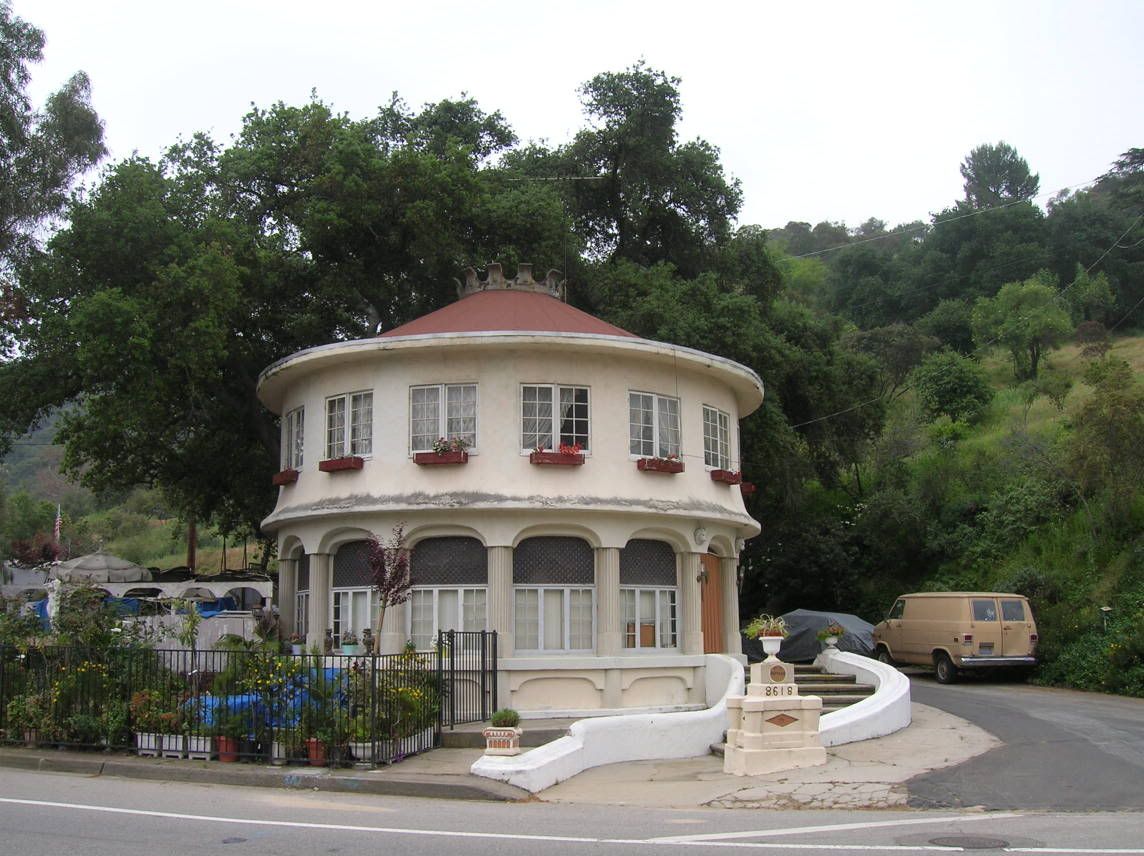
13. May use new materials and lead to innovation of new building techniques
This link to experimental design in England does not suggest something very modern, but designs of round houses have improved a lot. What the round house did accomplish were eco-friendly goals and these beat most modern rectangular house hands down.
14. May be easier on the eyes
From very ancient times, our ancestors knew the beauty of round circles and communities of different types of round houses have survived for millenia.
15. May be more energy efficient.
The newer designs for round houses are obviously more energy efficient.
16. May be more robot friendly
Robots can negotiate a round house by going round in circles. They don't get caught in corners! Does that mean that round houses will be the future. What do you think?
17. May be more user friendly
What are round house like to live in? They do fetch a good price because of their rarity.
Life Consequences of Misunderstood or Only Partially Understood Laws
 NYC SKYLINE WAS CHANGED BY EVENTS
We might ask who was ultimately responsible for the events of 911 in New York, and if we do we are presenting the question from the space-time world of classical physics. The tendency is to think that something was done to America, rather than to think that America attracted a negative force. The events of 911 were America's wake up call. There are those that see such damning events as arising through what is referred to as the secret. This approach suggests that American's attracted their own karma or destructive force. In a way this is true, but we do not ultimately know whether the force operated from with America or came from outside. There are some who write very interesting material on their own personal experience with the secret, the laws of attraction. In contrast, I, then proposed my ideas of 'the laws of association,' which fall within a cause-effect dynamic rather than an acausal 'quantum' or 'semi-mythological' dynamic. This was my response to the notion that your mind has to be tuned into the positive vibrations of the universe, which I think is correct. The problem still remains that the distribution of benefits is hierarchical, very uneven, because the skills of the the tuning instruments in our respective brains is distributed unevenly! In other words, even if the 'mythological' laws of attraction do work, some people are better at initiating them than others because they have brains that are more easily tuned to the positive vibrations.
The laws of attraction assume that events happen because of something that you do to attract them. The laws of association assume that events happen because of something that you do to associate yourself with the sources of events. In many ways, the laws of attraction and the laws of association are very similar, but there are subtle differences. The laws of association are closer to laws that you can research and can verify by means of the scientific method. You need science. The laws of attraction are not yet laws that you can verify by the scientific method. You need faith. The laws of attraction are not verifiable because they are based on a wonderful mythology of waves with agents at the source of the waves who are actually working with or on you for whatever reason, but mythology, nevertheless, has its value.
As an aside, when I write my blogs, I am trying to lead the reader down a pathway, a dynamic of thought, that the reader might not otherwise follow. Initially, the reader may or may not be attracted to the title of my blog page. By associating with the page, the reader will learn how to think and this will be an importance step towards independence and freer movement of thought and living. My ideas will attempt to point in directions that will give greater freedom in terms of moving towards a longer length of life. This approach emphasizes the economics of the life cycle that are often forgotten. If you extend your life by living longer, then you do the impossible. What you do not want to do is attract death by associating with those things that increase your probability of dying. If you engage in risky behaviour of any sort, you may attract forces of association, as well, as attraction. Now that's a thought, so be careful.
We forget economics at our peril for it is the economic laws that really govern our universe and not the physical laws. The beauty of the economic laws is that they include us and our dynamic in ways that we would not expect. The laws of economics are all powerful as the Fed is just now realizing as it tries to bring America back from the brink of disaster. What Americans do not realize is that terrorism has as its most effective weapons, the seeds of destruction with the agent of destruction arising from within the victim's own tendencies of excess and addiction. If America is addicted to war then planting the seeds of war will ultimately lead to its destruction. Yes, the seeds of war have been planted, but they are to be understood as coming from within the weaknesses of the US economy and its inherent social instability. Watch the series OZ about the Ozwald maximum security prison to see what I mean.
The seeds of war that are planted by terrorists aim a redirecting destructive tendency of Americans towards addictive processes that can be easily manipulated and lead to unpredictable social consequences. Inflation, debt, doubts about commercial trust, monopolization of resources, excessive ownership, excessive consumption, wasting of energy and fragile resources such as wild animals, dominance of the military sector of the economy, inward migration beyond absorptive capacity, mismanaged or misguided fiscal policy, excessive dependency on imports, and so on. Remember that how we treat our animals is a reflection of our nature. We do best to move away from a violent nature and treat our animals with the love and respect they can thrive on.
Friday, 14 March 2008
Is the Profit Motive for New Therapeutic Chemical Entities Correct?

WUH LAX WAS SURPRISED AT ME !
Who said that the profit motive works? If the profit motive worked, we would have saved billions of lives of people in developing countries who have died of disease. As it is, the children have died and we are responsible for not pushing our governments in Western economise to act more decisively and more effectively. I can think of no better solution to many economic problems that an over expansion of the therapeutic research at government expense ... forget the private sector. It has failed to deliver the goods to the third world. Why should we help the third world fight disease?
That to me is almost a stupid question, but my children tell me not to use the word stupid, so I will say that it is an insane question. Are we insane not to give everything we have got to eradicating the problems of the third world. I think the whole of Western Civilization is pretty damn insane not to. we talk about being Christians, and we talk about being Islamic and yet we have so many people dying from disease in third world countries that we should all be thoroughly ashamed. Disease is every one's problem.
The West is so caught up in its struggle against cancer that it has forgotten the many more dying of diseases that we can actually cure. And, incidentally in the process we may just get to grips with some of the disease issues in the West that are connected to those of third world countries.
But, the insane part of this whole matter is the patent system that we are using to calm our feelings of guilt. No, our governments should fund at public expense massive amounts of research that is presently going into weapons of mass destruction and bullets, not to mention bombs and tanks. To not help our third world countries fight disease is insane economics.
Why does Bill Gates have to show our people the right direction? He has done enough to create the microcomputer revolution. Three cheers for Bill and his lovely wife! Our governments can lower interest rates for the banks, but they can't fund research into disease solutions. That is insanity at its worst and we are all part of that insanity. Help the people of the world. Help the children who are dying by helping to eradicate the diseases around the world that ravage their populations. Our globe is getting smaller and smaller and we need to think of each other as being like close neighbours, giving our neighbours a helping hand.
Why does Bill Gates have to show our people the right direction? He has done enough to create the microcomputer revolution. Three cheers for Bill and his lovely wife! Our governments can lower interest rates for the banks, but they can't fund research into disease solutions. That is insanity at its worst and we are all part of that insanity. Help the people of the world. Help the children who are dying by helping to eradicate the diseases around the world that ravage their populations. Our globe is getting smaller and smaller and we need to think of each other as being like close neighbours, giving our neighbours a helping hand.
Really Useful Boxes - North American Distribution Opportunity!

THE DARTMOOR STONE MOVER by AW LAKE
You can't image how useful these boxes are. And, they seem to be without a North American distributor despite being offered on the Internet through various distributors. There seems to be an opportunity now for some budding capitalist entrepreneur to get a license to sell or manufacture the really useful boxes for distribution in North America. If you are an artist, you need to check them out. They are a really useful way to transport and store your paintings.
Maximizing Value or Efficiency But Not Both

WUH LAX AND THE COSMIC LANTERN
Economists can't have it both ways. On the one hand, they know that competition is imperfect, but, on the other hand, they talk about maximizing value and the need for competition. My point is that the two are incompatible most of the time because people generally do not know what is best for their environment.
Economics is bunk, not history! History is the story of economics and economic theory being bunk. People rarely take into account the needs on anything other than people. The importance of plants and animals in the world environment and economic equation is rarely included adequately because people generally are ignorant or just don't care about plants and animals, or other creatures of the earth.
Economists talk of general equilibrium, but they do not account for the disequilibrium of technology nor the environment. Governments can do away with valuable research programs to break away at the edges of our ignorance on energy creation because there is no real economics to argue for or against such programs, just awareness that they are probably, though not definitely right. Economists rarely take risk and uncertainty into account adequately. They don't know how to forecast technology, which would be the first requirement. They don't understand science which would be the second requirement, and they are hopeless at understanding knowledge creation, which would be the third requirement. Ask yourself whether the long term research programs the world needs are being supported by governments and you will probably get a negative answer.
At the Organization for Economic Cooperation and Development, the OECD, governments have think tanks to discuss appropriate measures for new technology creation and dissemination. Do governments read and understand what is coming down the 'turnpike?' Do they really have any idea how we can reduce CO2 emissions in the next twenty years. Are governments and business prepared to act decisively to ensure a safe distance away from earth's environmental destruction. Is China on board? What do you think is the priority now? What technology issues do you think are important? Extend your coffee break and think more deeply about the real issues that you can detect in a world of confused priorities.
Thursday, 13 March 2008
Economists Search For Equilibrium
 BICKLEIGH CASTLE
A constant theme in economic thought has been that of equilibrium. But, the search for equilibrium was always elusive. Even Karl Marx in his Das Kapital was under the illusion that an economic system would at some time reach an equilibrium. Others knew better, and it was Joseph Schumpeter, a Harvard professor and economic historian, who was studying business cycles, concluded that the capitalist economic system, and for that matter any economic system did not linger in an equilibrium. He even felt that there was no dynamic equilibrium, and pointed to new commodities as the reason. Economies are constantly subject to innovation he wrote.
The most famous macro economist of all time John Maynard Keynes also concluded that economies rarely reached an equilibrium. This did not stop classical and neoclassical economists from assuming equilibrium in their models. What resulted was the great schism between those that assumed economies would attain equilibrium and those who in face of severe criticism maintained that economics were constantly adjusting and generally were to be found in a state of moving disequilibrium, albeit dynamic.
What amazes one after reading all this history of thought is that the economists who proposed equilibrium did not seem very sophisticated at political science, and after all the field had been named political economy. The reason is obvious. For if you shared one view of politics and wanted to maintain the status quo, whether you were communist, liberal, or conservative, you would want to view the economic world as being in equilibrium.
That you were totally wrong did not matter. You wished to believe in the myth of economic equilibrium. So entrenched were the ideas of the equilibrium people that they would stop students from getting post graduate degrees if they viewed the economic world as in disequilibrium. The left wingers and the right wingers would select leaders and they would agree amongst themselves to maintain an equilibrium of graduates who exposed there respective views of the economy and indirectly political philosophy.
Thus in return for two PhD graduates of equilibrium there would be in return two PhD graduates of disequilibrium. So the result was a state of equilibrium, you might think. But no! The problem was that no matter how much you avoided reality by allowing only mathematical models of equilibrium to pass a PhD, you would end up in disequilibrium because more students wanted to show that economies were in disequilibrium. So to solve the problem, PhD graduates proposing dissertations that exceeded the number of those producing theses of equilibrium were stopped from getting PhDs by being failed, or discouraged, or told to do more work so that they waited five years or more in a queue before attaining their PhDs. Such was the state of disequilibrium at the best British universities in the world when I was a post graduate student.
What is it like now?
Wednesday, 12 March 2008
What Some People are Saying About the Credit Crisis

History repeats itself. The story of economics is that new generations don't seem to have the capacity to learn from previous generations. Everyone seems to get wrapped up in a frenzy of greed and fear.
Few people around the world will remain unaffected by what is happening in America. It is unfortunate because of the numbers of older vulnerable people on fixed incomes that will be impacted severely. They worked to reap their rewards of retirement only to find the government had not drawn up the rules of play for the banking systems carefully enough and much of their futures were under threat from inaction and complacency.
When I, myself, noticed that much was seriously amiss with the US policies for lending and that it would produce an almighty housing crisis back in 2002, I said to myself, "Here we go again. Its as if the only country that knows how to contain these things is Australia, and that's because it was so very severe there so long ago. Don't people remember the property loan crisis in Texas at the start of the Regan presidency? Look what that did!" It forced me to do things in anticipation of disaster that others thought were pretty crazy. "Well," I said, "If you buy a property in the wrong place right now you will be strangling yourself with a steep mortgage for the rest of your life. I don't intend to do that." Of course, no one listened, not even my own family. "The government would never let such a situation arise," was the reaction I was getting. Yes, faith in a government that had the blinkers on. Just read the reports of the time and judge for yourself.
An explanation of the current sub-prime mortgage crisis can be found on wikipedia. The thing to realize is that the situation is getting worse as the full scale of problems emerges and the global financial system gets to grips with the severity of what has happened to lending in the United States.
Internationally, the crisis was easily evident in the summer of 2007. The full facts of the severity were not visible to policy makers because of the way the loans were packaged and netered banking accounting systems after being bought and sold like commodities. Reporters realized that the crisis was spreading rapidly into much of the economy as Vikas Baja and Louise Story reported in the New York Times in February. Those of us that watched people in Cleveland losing their homes were already very worried.
Fiona Lake reported on the way the crisis was being handled around the world.
SOME INTERESTING LINKS:
- Primary Mortgages
- Tom Bawden on potential home loan defaults TimesOnLine
- Urjit Patel on aspects of international situation arising from the crisis Brookings
Home equity loans
- Robin SidelWall Street Journal
- Ruth Simon Wall Street Journal
- Consumer loans
- Ben Bernanke urged banks to act quickly to avoid recessionary forces getting out of hand.
- Spending and credit cards
- Scott Lanman - Bloomberg
- World Situation - Phil Izzo - Wall Street Journal
- Stock Market
- Peter McKay Wall Street Journal
- Phil Izzo compiles economists reaction Wall Street Journal
A Review of Fooled by Randomness by Nassim Nicholas Taleb
 If you are a stock market investor, this is the book you should be reading if you have not done so already. It would have been easier for you had you absorbed what Taleb has to say many years ago, but now you have had a taste of the negative, you can turn your efforts into the positive. I remember attending the lectures of John Kenneth Galbraith who spoke often of stock market crashes. His ideas were based on a thorough reading and analysis of the 1929 crash. Investing in the stock market is gambling, but it may be the only way that the 'small' investor has to get a portion of the capitalist economic pie. The rewards of investing in stocks and shares can be considerable, but the small investor has always to be aware of the sharks and black holes.
What Taleb does very well is show how self deception can dominate stock market and for that matter credit market advice giving to the point where it absorbs most of the capital of investors who lose almost everything. I might add, in one foul swoop. That's the danger, the risk, the eventual out turn from speculation that is completely outside one's control. We see the Donald Trumps of this world and expect that he has some secrets that he can share. The only problem is that a host of Trump wannabees have lost heavily in the property market. What's Trump's secret you wonder?
Well, you need to read Taleb's book and you will begin to understand how those investing also hedge. Hedging is when you take the risk out of investing realizing that you are not an expert investor or adviser, but part of a largely random process that can be terribly destructive of valuation of capital and almost everything else.
In the UK, the individual in the civil service who mailed a package containing a disk with people's private information thought that he knew the mail system, that it was secure. The upshot was that the individual took a risk and almost everyone in the country, almost 25 million people, lost big time. It would have been better for the government to install a fail safe system of auditing so as not to risk people's private information. This is what hedging is all about. Its about making sure that you are not exposed to risk. You carry on your business. You make money. But, you do not take unnecessary risk.
In foreign exchange operations, CLS Bank, does this very task of eliminating certain kinds of risk. FX dealers hedge their currency positions all the time so that their banks are not exposed to unnecessary risk. When I worked in Barclays Bank we were put on courses that showed us how to build a currency book and maturity ladder that got you where you wanted to be, largely without risk taking. That's the way money remains with you.
This is what the IMF SDR valuation is all about. Smart countries follow the SDR valuations of their currencies so as to avoid risk, avoid Asian financial implosion! What do you think China is doing? If it followed the advice of the US authorities it might be taking unnecessary risk so it has to monitor the value of its currency against all the major currencies. This way it avoids the rsik of an implosion and disasterous surprise and gradually moves in the direction it needs to move. Look at the Chinese exchange rate. Is is moving in the right direction? This is a question that you need to ask in a period of wild speculation in oil as a commodity.
Wednesday, 2 January 2008
On the One Hand, but On the Other Hand
At this moment, I feel very much like Larry David, when he holds out two hands. He is weighing what appear to be two alternatives, either the prescription from his doctor or the advice of his pharmacist which proposes an alternative prescription. The world is so made that we have alternatives, and it was my luck that I chose at a university age the science of alternatives, economics.
In this hand I have this alternative, but in this hand I have this other alternative
If you are not trained as an economist you perhaps will not appreciate what science there is in economics while at the same time appreciating what science is missing from economics. My bad luck was that I tried, in my own small way, to make economics less of a linear exercise and more scientific. The problem is that the whole field fails when one introduces science and technology. Most economists won't admit that there is a very serious problem, but there is a very serious problem with the notion that economics is a science. I found the science of economics to be more like a religion than a science despite its mathematical 'certainties.'
If you ever become an economist, you will appreciate what I mean when I say that the field is now esoteric and probably as esoteric as any religion. This is not to say that there are not practicalities in the economic field, its just that there are very few certainties. Where economics as a practical science succeeds it does so because it is able to incorporate the economic lessons of the past, make use of economic history, measure economic trends and economic potentials using statistics and econometrics.
Verification is all important in any scientific field, and in a field where there seems to be too much theory, too many assumptions, and too many conditions of an if then nature, more verification is like an act of God. Very few economists can verify all the ifs of their problem set. They can conjecture with maybe this or maybe that, but don't really know how to handle all the ifs.
Certainties and Uncertainties
What started me down this train of thought is the juxtaposition of two very important selected clubs of experts in modern society. One is the Group of Elders , the men of world peace, which includes such wonderful people as Jimmy Carter and Nelson Mandela, and the other is the Reality Group, the men of inventive science, which includes such speculative science people as Richard Dawkins and Paul Davies. So in my hands, I am weighing these two groups, one seems religious and one seems speculatively scientific. There are other groups that appear to be just brilliant.
As an economist, I could do the Larry David thing and think that on the one hand, we have The Elders and in the other hand, we have the Reality Group. Related to or embodying the Reality Group are the third culture people or The Edge people, which seems to include people like Lee Smolin, and then there are The Digerati that includes people like Bill Gates and Esther Dyson.
Fortunately, I realize that most people interact with many types of people, those with great heart, those with verifying minds, those that are doers and those that are thinkers. What an amazing mix the world of people is!
In My Non-Linear World, the Light World that I Occupy
On the one hand I am in control, but on the other I am not. It's a strange world.
On the one hand I must be like God, but on the other I must be nothing like God. I am amazing and yet I am insignificant. I am large and yet I am small. Who and what am I?
I did not choose to be born the person I am. I am fortunate to be born into the body that I possess, but don't really control, or if I do I must be a creature of light. I am grateful that I have so many fiends in the same boat as I am in, who did not choose to be born, but who are grateful that they were.
I am not sure that it matters whether I think this or that because I am what I am and I do not think that I have much choice in my reality, nor do I think many people have much choice. I do not think that my actions change my reality even though I am deluded into thinking that I experience a world which I can't possibly experience unless I am as fast as light. Maybe I am light. Wow! Me, a photon? Are you one too?
In this hand I have this alternative, but in this hand I have this other alternative
If you are not trained as an economist you perhaps will not appreciate what science there is in economics while at the same time appreciating what science is missing from economics. My bad luck was that I tried, in my own small way, to make economics less of a linear exercise and more scientific. The problem is that the whole field fails when one introduces science and technology. Most economists won't admit that there is a very serious problem, but there is a very serious problem with the notion that economics is a science. I found the science of economics to be more like a religion than a science despite its mathematical 'certainties.'
If you ever become an economist, you will appreciate what I mean when I say that the field is now esoteric and probably as esoteric as any religion. This is not to say that there are not practicalities in the economic field, its just that there are very few certainties. Where economics as a practical science succeeds it does so because it is able to incorporate the economic lessons of the past, make use of economic history, measure economic trends and economic potentials using statistics and econometrics.
Verification is all important in any scientific field, and in a field where there seems to be too much theory, too many assumptions, and too many conditions of an if then nature, more verification is like an act of God. Very few economists can verify all the ifs of their problem set. They can conjecture with maybe this or maybe that, but don't really know how to handle all the ifs.
Certainties and Uncertainties
What started me down this train of thought is the juxtaposition of two very important selected clubs of experts in modern society. One is the Group of Elders , the men of world peace, which includes such wonderful people as Jimmy Carter and Nelson Mandela, and the other is the Reality Group, the men of inventive science, which includes such speculative science people as Richard Dawkins and Paul Davies. So in my hands, I am weighing these two groups, one seems religious and one seems speculatively scientific. There are other groups that appear to be just brilliant.
As an economist, I could do the Larry David thing and think that on the one hand, we have The Elders and in the other hand, we have the Reality Group. Related to or embodying the Reality Group are the third culture people or The Edge people, which seems to include people like Lee Smolin, and then there are The Digerati that includes people like Bill Gates and Esther Dyson.
Fortunately, I realize that most people interact with many types of people, those with great heart, those with verifying minds, those that are doers and those that are thinkers. What an amazing mix the world of people is!
In My Non-Linear World, the Light World that I Occupy
On the one hand I am in control, but on the other I am not. It's a strange world.
On the one hand I must be like God, but on the other I must be nothing like God. I am amazing and yet I am insignificant. I am large and yet I am small. Who and what am I?
I did not choose to be born the person I am. I am fortunate to be born into the body that I possess, but don't really control, or if I do I must be a creature of light. I am grateful that I have so many fiends in the same boat as I am in, who did not choose to be born, but who are grateful that they were.
I am not sure that it matters whether I think this or that because I am what I am and I do not think that I have much choice in my reality, nor do I think many people have much choice. I do not think that my actions change my reality even though I am deluded into thinking that I experience a world which I can't possibly experience unless I am as fast as light. Maybe I am light. Wow! Me, a photon? Are you one too?
Subscribe to:
Posts (Atom)