The country’s Constitution was promulgated on July 17, 1948 after a month and half of work for its enactment. The government observes it as a national holiday. The first amendment to the Constitution was made in July 1952, while the 9th and last amendment was passed by referendum on October 27, 1987.
The country’s Constitution adopts liberal democracy as the basic principle of governance. The Constitution guarantees the people’s freedom and rights under various laws. It also guarantees equal opportunities in all sectors, including politics, economy, society and culture, and recognizes the necessity of establishing a welfare state. The Constitution also stipulates that all people have the obligation to pay taxes, engage in national defense, educate their children, and work.
The Constitution states that the country should endeavor to maintain international peace. It stipulates that international treaties signed by the country and generally accepted international laws have the same effects as domestic laws. Under the Constitution, the status of aliens is guaranteed in accordance with international laws and treaties.
Human Bone Reveals How Much Radiation Hiroshima Bomb Released — And It's Staggering
By Laura Geggel, Senior Writer |
This story was updated May 1 at 10:48 a.m. EDT.
On Aug. 6, 1945, the United States dropped an atomic bomb nicknamed "Little Boy" on Hiroshima, Japan, leading to a nuclear blast that instantly claimed about 45,000 lives. Now, the jawbone of one of those casualties — belonging to a person who was less than a mile from the bomb's hypocenter — is helping researchers determine how much radiation was absorbed by the bones of the victims, a new study finds.
The amount is staggering: Analyses show that the jawbone's radiation dose was about 9.46 grays (Gy). A Gy is the absorption of one joule of radiation energy per kilogram of matter, which in this case is bone. [5 Everyday Things That Are Radioactive]
"About half that dose, or 5 Gy, is fatal if the entire body is exposed to it," study co-researcher Oswaldo Baffa, a professor at the University of São Paulo's Ribeirão Preto School of Philosophy, Science & Letters, said in a statement.
Previous studies have measured other aspects of the bomb's catastrophic effects, including the radiation dose victims were exposed to from nuclear fallout (which is radioactive dust) and how the fallout affected human DNA and health, the researchers said.
However, this is the first study to use a victim's bone as a dosimeter — a tool that allows scientists to measure an absorbed dose of ionizing radiation, the researchers said. Moreover, the technique the scientists used — known as electron spin resonance (ESR) — is a precise method that can measure radiation dose in future nuclear events, the researchers said.
The victim's jaw was found about a mile (1.5 kilometers) from the atomic bomb hypocenter in Hiroshima, Japan.
Credit: Kinoshita et al./PLoS ONE/CC by 4.0
"Currently, there's renewed interest in this kind of methodology due to the risk of terrorist attacks in countries like the United States," Baffa said. Techniques such as this one "can help identify who has been exposed to radioactive fallout and needs treatment" in the event of a nuclear attack, he added.
Decades-long research
The new finding is decades in the making. In the 1970s, study senior researcher Sérgio Mascarenhas, who was then a physicist at the University of São Paulo's São Carlos Physics Institute, discovered that X-ray and gamma-ray irradiation made human bones slightly magnetic, according to the statement.
This phenomenon — called paramagnetism — happens because the bone contains a mineral called hydroxyapatite. When bone is irradiated, it produces CO2- that shows up in the hydroxyapatite. The resulting free radicals can then be used as a marker for radiation dose in bone.
At first, Mascarenhas thought he would use this technique to date ancient bones for archaeologists. His research was so widely lauded that Harvard University invited him to teach. On one trip from Brazil in 1972, Mascarenhas stopped in Japan so he could test the method on the remains of people from the Hiroshima blast.
"They gave me a jawbone, and I decided to measure the radiation right there, at Hiroshima University," Mascarenhas said in the statement. "I needed to prove experimentally that my discovery was genuine."
His analysis was rudimentary; the lack of advanced computers meant that the estimate couldn't separate the atomic-bomb-induced signal from the background signal. Even so,he presented the results at the American Physical Society's annual March Meeting in Washington, D.C., in 1973.
Mascarenhas was allowed to keep the jawbone and brought it back with him to Brazil.
New analysis
Thanks to new advances in technology, researchers are now able to separate the background signal from the radiation dose from the nuclear attack. [Doomsday: 9 Real Ways Earth Could End]
"The background signal is a broad line that may be produced by various different things and lacks a specific signature," Baffa said. "The dosimetric signal is spectral. Each free radical resonates at a certain point on the spectrum when exposed to a magnetic field."
When the U.S. dropped the atomic bomb, the weapon exploded about 1,900 feet (580 meters) above Hiroshima, Live Science previously reported. The person whose jaw the researchers examined was about 0.9 miles (1.5 kilometers) from the bomb's hypocenter, or the spot below the bomb's blast.
To study the bone, the researchers removed a small piece that was used in the previous study and then irradiated that piece in the lab, a process known as the additive dose method.
"We added radiation to the material and measured the rise in the dosimetric signal," Baffa said. By extrapolating from this signal, the researchers were able measure other samples, including different parts of the jawbone.
This technique allowed them to determine the radiation dose the bone received, which was similar to the dose distribution found in different materials around Hiroshima, including wall bricks and roof tiles, the researchers said.
"The measurement we obtained in this latest study is more reliable and up to date than the preliminary finding, but I'm currently evaluating a methodology that's about a thousand times more sensitive than" ESR, Mascarenhas said. "We'll have news in a few months."
Mueller Has Dozens of Inquiries for Trump in Broad Quest on Russia Ties and Obstruction
Robert S. Mueller III is said to be trying to determine whether the president had criminal intent when he fired James B. Comey, the F.B.I. director.J. Scott Applewhite/Associated Press
WASHINGTON — Robert S. Mueller III, the special counsel investigating Russia's election interference, has at least four dozen questions on an exhaustive array of subjects he wants to ask President Trump to learn more about his ties to Russia and determine whether he obstructed the inquiry itself, according to a list of the questions obtained by The New York Times.
The open-ended queries appear to be an attempt to penetrate the president's thinking, to get at the motivation behind some of his most combative Twitter posts and to examine his relationships with his family and his closest advisers. They deal chiefly with the president's high-profile firings of the F.B.I. director and his first national security adviser, his treatment of Attorney General Jeff Sessions and a 2016 Trump Tower meeting between campaign officials and Russians offering dirt on Hillary Clinton.
But they also touch on the president's businesses; any discussions with his longtime personal lawyer, Michael D. Cohen, about a Moscow real estate deal; whether the president knew of any attempt by Mr. Trump's son-in-law, Jared Kushner, to set up a back channel to Russia during the transition; any contacts he had with Roger J. Stone Jr., a longtime adviser who claimed to have inside information about Democratic email hackings; and what happened during Mr. Trump's 2013 trip to Moscow for the Miss Universe pageant.
President Trump said on Twitter on Tuesday that it was "disgraceful" that questions the special counsel would like to ask him were publicly disclosed, and he incorrectly noted that there were no questions about collusion. The president also said collusion was a "phony" crime.
The questions provide the most detailed look yet inside Mr. Mueller's investigation, which has been shrouded in secrecy since he was appointed nearly a year ago. The majority relate to possible obstruction of justice, demonstrating how an investigation into Russia's election meddling grew to include an examination of the president's conduct in office. Among them are queries on any discussions Mr. Trump had about his attempts to fire Mr. Mueller himself and what the president knew about possible pardon offers to Mr. Flynn.
"What efforts were made to reach out to Mr. Flynn about seeking immunity or possible pardon?" Mr. Mueller planned to ask, according to questions read by the special counsel investigators to the president's lawyers, who compiled them into a list. That document was provided to The Times by a person outside Mr. Trump's legal team.
A few questions reveal that Mr. Mueller is still investigating possible coordination between the Trump campaign and Russia. In one of the more tantalizing inquiries, Mr. Mueller asks what Mr. Trump knew about campaign aides, including the former chairman Paul Manafort, seeking assistance from Moscow: "What knowledge did you have of any outreach by your campaign, including by Paul Manafort, to Russia about potential assistance to the campaign?" No such outreach has been revealed publicly.
Jay Sekulow, a lawyer for Mr. Trump, declined to comment. A spokesman for the special counsel's office did not respond to a request for comment.
The questions serve as a reminder of the chaotic first 15 months of the Trump presidency and the transition and campaign before that. Mr. Mueller wanted to inquire about public threats the president made, conflicting statements from Mr. Trump and White House aides, the president's private admissions to Russian officials, a secret meeting at an island resort, WikiLeaks, salacious accusations and dramatic congressional testimony.
The special counsel also sought information from the president about his relationship with Russia. Mr. Mueller would like to ask Mr. Trump whether he had any discussions during the campaign about any meetings with President Vladimir V. Putin of Russia and whether he spoke to others about either American sanctions against Russia or meeting with Mr. Putin.
Through his questions, Mr. Mueller also tries to tease out Mr. Trump's views on law enforcement officials and whether he sees them as independent investigators or people who should loyally protect him.
For example, when the F.B.I. director, James B. Comey, was fired, the White House said he broke with Justice Department policy and spoke publicly about the investigation into Mrs. Clinton's email server. Mr. Mueller's questions put that statement to the test. He wants to ask why, time and again, Mr. Trump expressed no concerns with whether Mr. Comey had abided by policy. Rather, in statements in private and on national television, Mr. Trump suggested that Mr. Comey was fired because of the Russia investigation.
Many of the questions surround Mr. Trump's relationship with Mr. Sessions, including the attorney general's decision to recuse himself from the Russia investigation and whether Mr. Trump told Mr. Sessions he needed him in place for protection.
Mr. Mueller appears to be investigating how Mr. Trump took steps last year to fire Mr. Mueller himself. The president relented after the White House counsel, Donald F. McGahn II, threatened to resign, an episode that the special counsel wants to ask about.
"What consideration and discussions did you have regarding terminating the special counsel in June of 2017?" Mr. Mueller planned to ask, according to the list of questions. "What did you think and do in reaction to Jan. 25, 2018, story about the termination of the special counsel and Don McGahn backing you off the termination?" he planned to ask, referring to the Times article that broke the news of the confrontation.
Mr. Mueller has sought for months to question the president, who has in turn expressed a desire, at times, to be interviewed, viewing it as an avenue to end the inquiry more quickly. His lawyers have been negotiating terms of an interview out of concern that their client — whose exaggerations, half-truths and outright falsehoods are well documented — could provide false statements or easily become distracted. Four people, including Mr. Flynn, have pleaded guilty to lying to investigators in the Russia inquiry.
The list of questions grew out of those negotiations. In January, Mr. Trump's lawyers gave Mr. Mueller several pages of written explanations about the president's role in the matters the special counsel is investigating. Concerned about putting the president in legal jeopardy, his lead lawyer, John Dowd, was trying to convince Mr. Mueller he did not need to interview Mr. Trump, according to people briefed on the matter.
Mr. Mueller was apparently unsatisfied. He told Mr. Dowd in early March that he needed to question the president directly to determine whether he had criminal intent when he fired Mr. Comey, the people said.
But Mr. Dowd held firm, and investigators for Mr. Mueller agreed days later to share during a meeting with Mr. Dowd the questions they wanted to ask Mr. Trump.
When Mr. Mueller's team relayed the questions, their tone and detailed nature cemented Mr. Dowd's view that the president should not sit for an interview. Despite Mr. Dowd's misgivings, Mr. Trump remained firm in his insistence that he meet with Mr. Mueller. About a week and a half after receiving the questions, Mr. Dowd resigned, concluding that his client was ignoring his advice.
Mr. Trump's new lawyer in the investigation and his longtime confidant, Rudolph W. Giuliani, met with Mr. Mueller last week and said he was trying to determine whether the special counsel and his staff were going to be "truly objective."
Mr. Mueller's endgame remains a mystery, even if he determines the president broke the law. A longstanding Justice Department legal finding says presidents cannot be charged with a crime while they are in office. The special counsel told Mr. Dowd in March that though the president's conduct is under scrutiny, he is not a target of the investigation, meaning Mr. Mueller does not expect to charge him.
The prospect of pardons is also among Mr. Mueller's inquiries, and whether Mr. Trump offered them to a pair of former top aides to influence their decisions about whether to cooperate with the special counsel investigation.
Mr. Dowd broached the idea with lawyers for both of the advisers, Mr. Flynn and Mr. Manafort, according to people with knowledge of the discussions. Mr. Manafort has pleaded not guilty on charges of money laundering and other financial crimes related to his work for the pro-Russia former president of Ukraine.
Mr. Flynn, a retired Army lieutenant general who was ousted from the White House in February 2017 amid revelations about contacts with the Russian ambassador to the United States, ultimately pleaded guilty last December to lying to federal authorities and agreed to cooperate with the special counsel.
"After General Flynn resigned, what calls or efforts were made by people associated with you to reach out to General Flynn or to discuss Flynn seeking immunity or possible pardon?" Mr. Mueller planned to ask.
A version of this article appears in print on , on Page A1 of the New York edition with the headline: Questions for President Show Depth of Inquiry Into Russian Meddling. Order Reprints | Today's Paper | Subscribe
What Mueller Wants to Ask Trump About Obstruction, and What It Means
The questions show the special counsel's focus on obstruction of justice and touch on some surprising other areas.
Robert S. Mueller III, the special counsel.Doug Mills/The New York Times
The special counsel, Robert S. Mueller III, recently provided President Trump's lawyers a list of questions he wants answered in an interview. The New York Times obtained the list; here are the questions, along with the context and significance of each. The questions fall into categories based on four broad subjects. They are not quoted verbatim, and some were condensed.
Questions related to Michael T. Flynn, the former national security adviser
Michael T. Flynn in December 2017.Chip Somodevilla/Getty Images North America
• What did you know about phone calls that Mr. Flynn made with the Russian ambassador, Sergey I. Kislyak, in late December 2016?
These questions revolve around whether Mr. Trump tried to obstruct justice to protect Mr. Flynn from prosecution. His phone calls with Mr. Kislyak are at the heart of that inquiry.
During the calls, Mr. Flynn urged Russia not to overreact to sanctions just announced by the Obama administration. But Mr. Trump's aides publicly denied that sanctions were discussed and, when questioned by the F.B.I., Mr. Flynn denied it, as well. Mr. Mueller wants to know whether Mr. Flynn was operating on Mr. Trump's behalf. Prosecutors may already know the answer: Mr. Flynn has pleaded guilty to lying and is cooperating with investigators.
• What was your reaction to news reports on Jan. 12, 2017, and Feb. 8-9, 2017?
In January, the Washington Post columnist David Ignatius revealed Mr. Flynn's phone calls with Mr. Kislyak. Mr. Ignatius questioned whether those conversations had violated a law prohibiting private citizens from attempting to undermine American policies. In February, The Washington Post revealed the true nature of Mr. Flynn's conversations with Mr. Kislyak.
Mr. Mueller wants to know, among other things, whether Mr. Trump feared that his national security adviser had broken the law and then tried to shield him from consequences.
• What did you know about Sally Yates's meetings about Mr. Flynn?
Ms. Yates, the acting attorney general for the first weeks of the Trump administration, twice warned the White House that Mr. Flynn was lying, and those lies made him vulnerable to Russian blackmail. No one from the White House has ever said how much Mr. Trump knew about those warnings.
• How was the decision made to fire Mr. Flynn on Feb. 13, 2017?
Eighteen days after Ms. Yates's warning, Mr. Flynn was asked to resign. The White House said that Mr. Trump lost confidence in Mr. Flynn because he had lied. But the White House has never fully explained why, after learning about the lie, officials waited so long to act.
• After the resignations, what efforts were made to reach out to Mr. Flynn about seeking immunity or possible pardon?
The Times recently revealed that, when Mr. Flynn began considering cooperating with the F.B.I., Mr. Trump's lawyers floated the idea of a pardon. Mr. Mueller wants to know why.
Questions related to James B. Comey, the former F.B.I. director
• What was your opinion of Mr. Comey during the transition?
The questions about Mr. Comey relate to whether Mr. Trump fired Mr. Comey last year to shield Mr. Flynn, or anyone else, from prosecution. Mr. Trump has denied that, saying he fired Mr. Comey because of his mishandling of the F.B.I.'s investigation into Hillary Clinton's use of a private email server.
This question is important because, if Mr. Trump truly was upset about the Clinton investigation, he would have shown an early distaste for Mr. Comey.
• What did you think about Mr. Comey's intelligence briefing on Jan. 6, 2017, about Russian election interference?
The briefing revealed that American intelligence agencies had concluded that Russian operatives meddled in the election to hurt Mrs. Clinton and to boost Mr. Trump. Mr. Trump has repeatedly cast doubt on these conclusions and said he believes the Russian president, Vladimir V. Putin, who denies any interference.
• What was your reaction to Mr. Comey's briefing that day about other intelligence matters?
This question addresses documents written by a retired British spy, Christopher Steele, who said that Russia had gathered compromising information on Mr. Trump. The documents, which became known as the Steele Dossier, also claim that the Trump campaign had ties to the Russian government. Mr. Comey privately briefed Mr. Trump about these documents.
• What was the purpose of your Jan. 27, 2017, dinner with Mr. Comey, and what was said?
A few weeks after his briefing, Mr. Comey was called to the White House for a private dinner. Mr. Comey's notes say that Mr. Trump raised concerns about the Steele Dossier and said he needed loyalty from his F.B.I. director. This question touches on Mr. Trump's true motivation for firing Mr. Comey: Was he dismissed because he was not loyal and would not shut down an F.B.I. investigation?
• What was the purpose of your Feb. 14, 2017, meeting with Mr. Comey, and what was said?
That was a key moment. Mr. Comey testified that the president told him, "I hope you can see your way clear to letting this go, to letting Flynn go." Mr. Trump has denied this.
• What did you know about the F.B.I.'s investigation into Mr. Flynn and Russia in the days leading up to Mr. Comey's testimony on March 20, 2017?
Mr. Comey's testimony publicly confirmed that the F.B.I. was investigating members of the Trump campaign for possible coordination with Russia. Mr. Mueller wants to know what role that revelation played in Mr. Comey's firing.
• What did you do in reaction to the March 20 testimony? Describe your contacts with intelligence officials.
In the aftermath,The Post reported, Mr. Trump asked the United States' top intelligence official, Daniel Coats, to pressure Mr. Comey to back off his investigation. Mr. Mueller wants to ask Mr. Trump about his contacts with Mr. Coats as well as the C.I.A.'s director at the time, Mike Pompeo, and the National Security Agency's director, Michael S. Rogers. The conversations could reflect Mr. Trump's growing frustration with Mr. Comey — not about the Clinton case, but about his refusal to shut down the Russia inquiry.
• What did you think and do in reaction to the news that the special counsel was speaking to Mr. Rogers, Mr. Pompeo and Mr. Coats?
It is not clear whether Mr. Mueller knows something specific about Mr. Trump's reaction to these interviews, but the question shows that Mr. Mueller is keenly interested in how Mr. Trump responded to each step of his investigation.
• What was the purpose of your calls to Mr. Comey on March 30 and April 11, 2017?
Mr. Comey said that Mr. Trump calledtwice to ask him to say publicly that he was not under F.B.I. investigation. In the second call, Mr. Comey said, the president added: "I have been very loyal to you, very loyal. We had that thing, you know."
• What was the purpose of your April 11, 2017, statement to Maria Bartiromo?
While the White House ultimately said Mr. Comey was fired for breaking with Justice Department policy and discussing the Clinton investigation, Mr. Trump expressed no such qualms in an interview with Ms. Bartiromo of Fox Business Network. "Director Comey was very, very good to Hillary Clinton, that I can tell you," he said. "If he weren't, she would be, right now, going to trial."
• What did you think and do about Mr. Comey's May 3, 2017, testimony?
In this Senate appearance, Mr. Comey described his handling of the Clinton investigation in detail. Mr. Comey was fired soon after. Mr. Mueller's question suggests he wants to know why Mr. Trump soured.
• Regarding the decision to fire Mr. Comey: When was it made? Why? Who played a role?
Over the past several months, Mr. Mueller has asked White House officials for the back story, and whether the public justification was accurate. He will be able to compare Mr. Trump's answers to what he has learned elsewhere.
• What did you mean when you told Russian diplomats on May 10, 2017, that firing Mr. Comey had taken the pressure off?
The day after Mr. Comey's firing, Mr. Trump met with Russian officials in the Oval Office. There, The Times revealed, Mr. Trump suggested he had fired Mr. Comey because of the pressure from the Russia investigation.
"I just fired the head of the F.B.I. He was crazy, a real nut job," Mr. Trump said. "I faced great pressure because of Russia. That's taken off."
• What did you mean in your interview with Lester Holt about Mr. Comey and Russia?
Shortly after firing Mr. Comey, Mr. Trump undercut his own argument when he told NBC News that he had been thinking about the Russia investigation when he fired Mr. Comey.
"I was going to fire Comey knowing there was no good time to do it. And in fact, when I decided to just do it, I said to myself — I said, you know, this Russia thing with Trump and Russia is a made-up story. It's an excuse by the Democrats for having lost an election that they should've won."
• What was the purpose of your May 12, 2017, tweet?
After The Times revealed the president's private dinner with Mr. Comey, Mr. Trump responded on Twitter.
Mr. Comey appeared unworried. "Lordy, I hope there are tapes," Mr. Comey said. The White House ultimately said that, no, there were no tapes.
• What did you think about Mr. Comey's June 8, 2017, testimony regarding Mr. Flynn, and what did you do about it?
After he was fired, Mr. Comey testified about his conversations with Mr. Trump and described him as preoccupied with the F.B.I.'s investigation into Russia. After the testimony, Mr. Trump called him a liar.
• What was the purpose of the September and October 2017 statements, including tweets, regarding an investigation of Mr. Comey?
Sarah Huckabee Sanders, the White House press secretary, said that Mr. Comey had testified falsely to Congress and suggested that the Justice Department might investigate. Mr. Trump followed up with tweets suggesting that he should be investigated for rigging an inquiry into Mrs. Clinton. Such comments reinforced criticism that Mr. Trump views the Justice Department as a sword to use against his political rivals.
• What is the reason for your continued criticism of Mr. Comey and his former deputy, Andrew G. McCabe?
Mr. Comey and Mr. McCabe are among Mr. Trump's favorite targets. Mr. McCabe is a lifelong Republican, but Mr. Trump has criticized him as a Clinton loyalist because Mr. McCabe's wife, a Democrat, ran unsuccessfully for office in Virginia and received donations from a Clinton ally. This question suggests that Mr. Mueller wants to know whether Mr. Trump's criticism is an effort to damage the F.B.I. while it investigates the president's associates.
Questions related to Attorney General Jeff Sessions
Attorney General Jeff Sessions in April in Washington.Lawrence Jackson for The New York Times
• What did you think and do regarding the recusal of Mr. Sessions?
Mr. Trump has criticized Mr. Sessions's recusal from the Russia investigation. The Times reported that Mr. Trump humiliated him in an Oval Office meeting and accused him of being disloyal. Mr. Sessions ultimately submitted his resignation, though Mr. Trump did not accept it. Along with the next two questions, this inquiry looks at whether Mr. Trump views law enforcement officials as protectors.
• What efforts did you make to try to get him to change his mind?
The Times has reported that Mr. Trump told his White House counsel, Donald F. McGahn II, to stop Mr. Sessions from recusing himself. Mr. McGahn was unsuccessful, and Mr. Trump erupted, saying he needed an attorney general who would protect him.
• Did you discuss whether Mr. Sessions would protect you, and reference past attorneys general?
Mr. Trump has spoken affectionately about past attorneys general who he said were loyal to their presidents. He cited Robert F. Kennedy and Eric H. Holder Jr.as examples. "Holder protected the president," he said in a Times interview in December. "And I have great respect for that."
• What did you think and what did you do in reaction to the news of the appointment of the special counsel?
In a twist, Mr. Mueller's very appointment has become part of his investigation. Mr. Trump has repeatedly denounced the inquiry as a "witch hunt." Mr. Trump blames the appointment on Mr. Sessions's recusal.
• Why did you hold Mr. Sessions's resignation until May 31, 2017, and with whom did you discuss it?
Mr. Trump rejected Mr. Sessions's resignation after aides argued that it would only create more problems. The details of those discussions remain unclear, but Mr. Trump's advisers have already given Mr. Mueller their accounts of the conversations.
• What discussions did you have with Reince Priebus in July 2017 about obtaining the Sessions resignation? With whom did you discuss it?
Mr. Priebus, who was Mr. Trump's chief of staff, has said he raced out of the White House after Mr. Sessions and implored him not to resign. Mr. Mueller has interviewed Mr. Priebus and would be able to compare his answers with those of Mr. Trump.
• What discussions did you have regarding terminating the special counsel, and what did you do when that consideration was reported in January 2018?
Again, Mr. Mueller's investigation intersects with its own existence. The Times reported that, in June 2017, Mr. Trump ordered Mr. McGahn to fire Mr. Mueller. Mr. McGahn refused. Though Mr. Trump's own advisers informed Mr. Mueller about that effort, Mr. Trump denied it: "Fake news," he said. "A typical New York Times fake story."
• What was the purpose of your July 2017 criticism of Mr. Sessions?
Mr. Trump unleashed a series of attacks on Mr. Sessions in July.
Campaign Coordination With Russia
Donald Trump Jr. arranged a meeting with a Russian lawyer at Trump Tower in June 2016.Leah Millis/Reuters
• When did you become aware of the Trump Tower meeting?
This and other questions relate to a June 9, 2016, meeting at Trump Tower with a Russian lawyer who offered political dirt about Mrs. Clinton. Mr. Trump's eldest son, Donald Trump Jr., arranged the meeting. He said he did not tell his father about it when it happened.
• What involvement did you have in the communication strategy, including the release of Donald Trump Jr.'s emails?
When The Times found out about the meeting, Mr. Trump helped draft a misleading statement in his son's name, omitting the true purpose of the meeting. After The Times obtained the younger Mr. Trump's emails, he published them on Twitter.
• During a 2013 trip to Russia, what communication and relationships did you have with the Agalarovs and Russian government officials?
The Trump Tower meeting was arranged through the Russian singer Emin Agalarov, his billionaire father, Aras Agalarov, and a music promoter. Mr. Mueller is scrutinizing the nature of connections between the Agalarovs, Mr. Trump and Russian officials.
• What communication did you have with Michael D. Cohen, Felix Sater and others, including foreign nationals, about Russian real estate developments during the campaign?
Mr. Mueller is referring to a failed effort to build a Trump Tower in Moscow. Mr. Sater, a business associate, proposed the idea to Mr. Cohen, the longtime personal lawyer to Mr. Trump. Emails show that Mr. Sater believed that the project would showcase Mr. Trump's deal-making acumen and propel him into the presidency.
• What discussions did you have during the campaign regarding any meeting with Mr. Putin? Did you discuss it with others?
Journalists and lawmakers have uncovered several examples of Russian officials trying, through intermediaries, to arrange a meeting between Mr. Trump and Mr. Putin. Senior campaign officials rejected some overtures, but Mr. Trump's involvement has been a mystery.
• What discussions did you have during the campaign regarding Russian sanctions?
Even as the Obama administration stepped up sanctions on Russia, Mr. Trump struck a laudatory tone toward Mr. Putin.
• What involvement did you have concerning platform changes regarding arming Ukraine?
A portion of the Republican platform was changed in a way more favorable to Russia.
• During the campaign, what did you know about Russian hacking, use of social media or other acts aimed at the campaign?
This is a key question. Mr. Trump praised the release of hacked Democratic emails and called on Russia to find others. Mr. Mueller's investigation has unearthed evidence that at least one member of Mr. Trump's campaign — George Papadopoulos — was told that Russia had obtained compromising emails about Mrs. Clinton. But Mr. Trump has repeatedly said there was "no collusion" with the Russian government.
• What knowledge did you have of any outreach by your campaign, including by Paul Manafort, to Russia about potential assistance to the campaign?
This is one of the most intriguing questions on the list. It is not clear whether Mr. Mueller knows something new, but there is no publicly available information linking Mr. Manafort, the former campaign chairman, to such outreach. So his inclusion here is significant. Mr. Manafort's longtime colleague, Rick Gates, is cooperating with Mr. Mueller.
• What did you know about communication between Roger Stone, his associates, Julian Assange or WikiLeaks?
Mr. Stone, a longtime adviser, claimed to have inside information from WikiLeaks, which published hacked Democratic emails. He appeared to predict future releases, and was in touch with a Twitter account used by Russian intelligence. This question, along with the next two, show that Mr. Mueller is still investigating possible campaign cooperation with Russia.
• What did you know during the transition about an attempt to establish back-channel communication to Russia, and Jared Kushner's efforts?
Mr. Kushner, Mr. Trump's son-in-law, has testified that the Russian ambassador proposed getting Mr. Flynn in contact with Russian officials to discuss Syria. In response, Mr. Kushner said, he proposed using secure phones inside the Russian Embassy — a highly unusual suggestion that was not accepted.
• What do you know about a 2017 meeting in Seychelles involving Erik Prince?
The meeting was convened by Mohammed bin Zayed Al-Nahyan of the United Arab Emirates. It brought Mr. Prince, an informal adviser to Mr. Trump's team, together with a Russian investor close to Mr. Putin.
• What do you know about a Ukrainian peace proposal provided to Mr. Cohen in 2017?
Mr. Cohen, the lawyer, hand-delivered to the White House a peace proposal for Ukraine and Russia. This unusual bit of backdoor diplomacy is of interest because it involved a Ukrainian lawmaker who said he was being encouraged by Mr. Putin's aides. Mr. Cohen has said he did not discuss the proposal with Mr. Trump.
Matt Apuzzo is a two-time Pulitzer Prize-winning reporter based in Washington. He has covered law enforcement and security matters for more than a decade and is the co-author of the book "Enemies Within."
Michael S. Schmidt is a Washington correspondent for The Times who covers national security and federal investigations. He was part of two teams that won Pulitzer Prizes in 2018 — one for reporting on workplace sexual harassment issues and the other for coverage of President Donald Trump and his campaign's ties to Russia.@NYTMike
Pakistani origin Sajid Javid appointed UK's first Muslim Home Secretary
British Pakistan politician Sajid Javid has been appointed Home Secretary of the United Kingdom hours after Amber Rudd resigned amid countrywide outrage over the Windrush scandal.
Born in 1969, Sajid Javid is a British Conservative Party politician and former managing director at Deutsche Bank.
He was born in Rochdale, Lancashire, one of five sons of parents of Pakistani descent.
His father was a bus driver.
Amber Rudd was under growing pressure after a challenge to her testimony on the deportation of immigrants prompted fresh calls for her resignation.
She has faced criticism over the existence of Home Office removals targets and her knowledge of them. The pressure on Rudd to stand down increased after she said the government didn't have targets for deporting people — only for a memo to emerge mentioning specific targets for enforced removals.
The resignation came hours after Rudd said she would stay in her job to ensure Britain's immigration policy is "humane." But opposition politicians had demanded that she should resign over the Windrush scandal.
The Guardian newspaper reported a letter from Rudd to Prime Minister Theresa May last year in which she stated an "ambitious but deliverable" aim for an increase in the enforced deportation of immigrants.
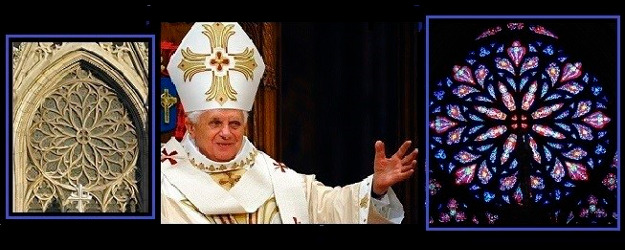
Pope Benedict XVI's allegory on faith and the search for truth, using the image of cathedral windows.
"I have often affirmed my conviction that the true apology of Christian faith, the most convincing demonstration of its truth…are the saints and the beauty that the faith has generated."1 Throughout his career, Joseph Ratzinger/Benedict XVI has, time and again, emphasized that the via pulchritudinis, the way of beauty, constitutes a privileged path by which to advance the New Evangelization. In a de-Christianized society that is often hostile to the Church's truth claims and moral norms, Benedict believes that recourse to the universal language of beauty is indispensable if today's evangelist is to compellingly present the Gospel to would-be believers. In this brief reflection, we will explore the concept of beauty in Benedict's theology and suggest areas in which it might be fruitfully applied by the Church today in her ministry of evangelization.
The nature of beauty and its power to convert
It is commonly said that "beauty lies in the eye of the beholder." There is certainly some truth to this saying. When it comes to some matters (say, whether you like a particular song or movie), there is considerable room for debate among people of good will as to whether a given work of art should be called "beautiful." Yet, to relegate beauty solely to the realm of the subjective gives rise to grave problems when pushed to its logical conclusion. This can be seen by the fact that there exist certain realities that any sane person would recognize as not beautiful. For an extremely obvious example, take the carnage of Auschwitz—not the acts of heroism by those imprisoned, but the brutal acts of aggression perpetrated upon them. If one is to call that beautiful, then one has clearly emptied the word "beauty" of all meaning.
So what is beauty? As we will discover below, Pope Benedict provides us with something different from a textbook definition of beauty. But for now, a good starting point is St. Thomas Aquinas whose thought mirrors a large part of the reflection on the subject. Within this tradition, beauty is described as having three hallmarks: integrity, proportion, and clarity, or luminosity. A piece of art possesses integrity when it is whole (a painting is not ripped in half); proportion occurs when a thing's various parts are all in proper relation with one another (the painting has not been drawn with twig-like limbs); clarity is that "shine" that allows for the self-revelation of the beautiful (a painting could possess integrity and proportion but lack adequate light).
For his part, Benedict draws on Plato to give us more of a phenomenological account describing the experience of beauty, rather than seeking to define its precise nature. He teaches us that the dominant effect of beauty is to give us a healthy "shock" that draws us out of ourselves, and the rut in which we sometimes find ourselves entrenched throughout our daily routine. Beauty gives us wings, lifting us up so that we may soar to the transcendent and rise to greatness. It "disturbs" us and even causes us suffering.2 Writing in a similar vein, Fr. Jacques Philippe reminds us that the Greek patristic tradition connected the beautiful, kalos, with the verb kalein, which means to call or summon. For Church Fathers like Dionysius the Areopagite, beauty thus beckons us to truth, to goodness, and to unity.3 C.S. Lewis, to whom Pope Benedict himself refers in this connection, gets to the heart of the matter when he says that created beauty provokes in us a longing to be united with, to receive into ourselves, and to enter into that infinite Beauty of which all created beauty is but a reflection.4 One of Benedict's favorite illustrations of this point can be seen in the medieval cathedral and its power to draw one toward the infinite. Upon crossing the threshold of God's house, one enters a space and time set apart from ordinary life. The upward thrust of the Gothic cathedral's walls is an invitation to prayer, intended to express in its architectural lines the soul's longing for God, while its stained-glass windows flood the building with the light of God.5
The universal language of beauty
In his lifelong process of meditating on beauty, Benedict has repeatedly touched on the various arts of painting, iconography, architecture, sculpture, music, film, and literature as vehicles for communicating the message of the Gospel. He tells us that these artistic forms speak a universal language, a language of parables. This is a language uniquely capable of speaking to those who seek God but who initially may not be open to hearing the Gospel message more directly. This is by no means to say that dogma is irrelevant. It simply means that for some people the path leading to the fullness of truth might first be entered through the door of an experience of beauty.6
Why this is the case can be readily understood upon a moment's reflection. How many times in our lives have we found our attempts to engage people on a moral or dogmatic issue stymied before the discussion even got off the ground? For many of us, this has also been our experience when attempting a dialogue with fellow Catholics on such issues. If it is a matter of politics, morals, or religion, we are told we should not impose our views on other people.
With this situation in mind, now consider a different scenario. Over the years, how many amicable conversations have you had with people about movies? When it comes to my experience in classroom teaching and parish evangelization, people who would otherwise be reluctant to discuss a moral issue with me are much more open to doing so when it emerges from a discussion of a film that broached the topic. Most recently, I have been showing people The Livesof Others," a German film that marvelously illustrates the power of beauty to convert souls. A benefit of the work is that it is not even implicitly Christian. The important line at a key point in the movie comes when one of its grieving characters plays a sonata and then asks: "Can anyone who has heard this music, I mean truly heard it, really be a bad person?" In the following scenes, the audience watches as the effects of this music are played out in the life of the film's protagonist. I use this scene as a way to raise the question of whether there is such a thing as objectively good or bad music—and, more importantly, whether one can say there are objectively good and bad things. One of my main goals in doing this is to challenge the widespread assumption that certain things "may not be good for me, but I can't say they are bad for someone else."
While my above comments focused on film, Benedict XVI also spends considerable time reflecting on images as outstanding means for communicating the Gospel. His comments introducing the Compendium to the Catechism of the Catholic Church are especially illuminating. The section of the work dedicated to artistic images is dear to Benedict because he sees in great art an antidote to what he calls today's "culture of images." Especially for young people who become estranged from the faith, Benedict tells us that "a sacred image can express much more than what can be said in words, and be an extremely effective and dynamic way of communicating the Gospel message."7 When teaching morality, I myself make abundant use of images like Caravaggio's "Calling of St. Matthew" to reflect upon our vocation to holiness, and how Christ wishes to "re-create" us through the gift of his grace. I also catechize my students through outstanding frescos by Raphael, medieval stained-glass windows, and renaissance sculpture. People today relate well to images, and it is relatively easy to comb the tradition and find compelling art to meet them where they are, and balance their daily aesthetic experience with a sacred, or at least wholesome, perspective. To paraphrase the great author, Flannery O'Connor, this art does not even have to be Christian, but it does have to be good art. Mediocre Christian art is not what Benedict has in mind in claiming that beauty has the power to convert souls.
The same principles apply to music. I often have my students listen to two different pieces, one after another, for example ACDC's "Highway to Hell" followed by the theme to the film, "Jurassic Park." Again, neither of these is even Christian, but the key is that a reaction is elicited in everyone who hears these two very different pieces. It is fascinating to ask people what happens in their souls when hearing each of them. The majestic orchestral piece by John Williams draws us out of ourselves, giving us a sense of awe, reverence, even nostalgia. It puts us in touch with our humanity, and makes us ponder higher things. Heavy metal music, on the other hand, hardly inspires an impulse for contemplation or charity. In Benedict's own words, rock music "is the expression of elemental passions, and at rock festivals it assumes a cultic character, a form of worship, in fact, in opposition to Christian worship."8 While Benedict's analysis may not cause us to give up all our rock music, it does provide us important food for thought, helping us to reflect upon why we listen to our music, and what we can do to better immerse ourselves in an aesthetic environment that will lift us up, rather than imprison us in a perpetual cycle of self-gratification.
In a couple of places, Benedict gives us an autobiographical glimpse into how the beauty of music bolsters his faith. One time after attending a Bach concert with a Lutheran bishop, the two spontaneously looked at each other and said, "Anyone who has heard this, knows that the faith is true." Benedict later reflected on the experience, saying: "The music had such an extraordinary force of reality that we realized, no longer by deduction, but by the impact on our hearts, that it could not have originated from nothingness, but could only have come to be through the power of the Truth that became real in the composer's inspiration."9
Benedict's account raises an important pastoral question that we need to ask ourselves: what are we doing concretely in our own parishes, schools, and dioceses to provide the faithful with opportunities to encounter the beautiful? How often do Catholics come out of Mass remarking how their experience put them in touch with the transcendent? For how many Catholics is their liturgical experience more moving than that of watching a movie or hearing secular music? When we think about this, it is no wonder why so many people find the Church unattractive. This is not to say that the Mass should be all about entertaining people, but let's face it: solemnity matters, and our experiences matter. The Church was once the greatest patron of the arts, and people flocked to her great cathedrals, not only to meet God, but also to be moved and inspired by man's artistic genius put at the service of God. Within our present culture, film has been termed the "new cathedral of the masses." So we must ask ourselves what we are doing in the Church to attract people in the absence of the cultural forces that once caused people to enter her sacred doors.
For its part, the Pontifical Council for Culture recommends that we consider three areas in which to promote beauty. First of all, it discusses beauty in creation. Think of John Paul II leading his students on outdoor hikes, catechizing them, celebrating Mass, and simply getting to know them as people. The council also discusses beauty in the arts. As I've been discussing, this involves such things as offering beautiful liturgies, and forming the faithful to appreciate great art. Finally, there is the beauty that comes through an encounter with Christ himself. We meet Christ especially in his word, in the liturgy, and in the saints. These are merely a few indications of areas in which to foster encounters with the beautiful in our Church today. Ultimately, each pastor and evangelist must prayerfully consider these principles in light of his community's concrete circumstances.10
Spiritual beauty
Pope Benedict's theology of beauty concerns not merely the arts, but even more importantly such matters as the liturgy, and our friendship with Christ, and the lives of the saints. Indeed, after praising the evangelizing role of beauty in the arts, the emeritus pontiff adds:
Yet, the beauty of Christian life is even more effective than art and imagery in the communication of the Gospel message. In the end, love alone is worthy of faith, and proves credible. The lives of the saints and martyrs demonstrate a singular beauty which fascinates and attracts, because a Christian life lived in fullness speaks without words. We need men and women whose lives are eloquent, and who know how to proclaim the Gospel with clarity and courage, with transparency of action, and with the joyful passion of charity.11
In connecting the lives of the saints with beauty as the primary apologia for the Christian faith, Benedict echoes the understanding of beauty that we find in St. Thomas Aquinas. The Angelic Doctor applies the three properties of beauty—integrity, proportion, and clarity—to the spiritual realm: "Spiritual beauty consists in a man's conduct or actions being well proportioned in respect of the spiritual clarity of reason."12 For St. Thomas, this all-important beauty lies precisely in the life of virtue. To live virtuously is to live a life of balance, to live in the clarity of right reason integrated into all our actions. To use Benedict's phrasing, these character traits form the "mosaic of holiness" by which the Christian disciple shines the light of Christ upon the world around him.
If we are striving to live the Gospel generously, the above qualities will shine through without a contrived effort on our part to put on a show and "attract" others by our Christian joy. That said, beginning in his very first papal homily, Pope Benedict emphasized the need for consciously making the effort to speak to others of our friendship with Jesus, a task he described in terms of beauty: "There is nothing more beautiful than to know him, and to speak to others of our friendship with him."13 At the conclusion of this same text, Benedict advanced a point which reflects a recurring theme in his thought: we evangelists need to share with people the good news that our friendship with Jesus does not hold us back from fulfilling our deepest desires. On the contrary, believe it or not, living a life in conformity with the demands of the Gospel actually makes us happy! As Benedict puts it, it is only in this friendship that we experience beauty and liberation.
In his first encyclical, co-authored with Benedict, the current Roman pontiff has emphasized this point, writing that "the light of faith is linked to concrete life-stories."14 An implication of this is that Christian disciples ought to cultivate a biblical memory of God's saving deeds in our own lives, letting this serve as a topic in our fraternal dialogue with those whom we wish to evangelize. In his critically important apostolic exhortation, Pope Francis has offered a brief roadmap of how to do this within an evangelizing conversation. We ought first and foremost to listen to those whom we wish to evangelize, and then share a story, a biblical text, or some other insight when we discern it to be appropriate. But for Francis, the emphasis must always remain upon what is essential and most beautiful by "always keeping in mind the fundamental message: the personal love of God who became man, who gave himself up for us, who is living, and who offers us his salvation and his friendship."15
Beauty and the liturgy
Benedict's theology of beauty has great ramifications for liturgy in the Church today. For example, we need to ask ourselves: do our sacred buildings and sacred art lift our spirits out of the ordinary and toward God, or do they let us remain in the comfort of the secular world around us? Note that this is not to say we need to replace all our churches with Gothic structures, and replace all contemporary music with Gregorian chant. We can only work with what God gives us, and we must always take care to properly catechize the faithful when making liturgical changes in the parish. That said, certainly all of our communities could stand to reflect more deeply on what we are doing to make the liturgy, and our faith life, something that draws us out of ourselves into an encounter with the transcendent.
In his writings on the liturgy and iconography, one can see that Pope Benedict's theology of beauty is hardly one of an aestheticism concerned with the technical perfection of art to the neglect of charity. In our desire to beautify our churches, we must not forget the need to meet the ordinary believer where he is. Though no one is a greater lover of liturgy, Benedict reminds us that it is easy to get caught up in an "elitist ghetto," neglecting the pedagogical art by which we must gradually introduce ordinary believers to the great riches of the Church's liturgical and artistic patrimony.16 The practical import of this point is critical for those of us who love beautiful liturgy, and traditional liturgy in particular. Liturgical solemnity attracts and delights us, but how easy it is to become so engrossed in achieving technical perfection that we forget how to relate to people, and sometimes even lose our original love that was the driving force for that very perfection!17
At the same time, it is worth mentioning an opposing temptation Catholic leaders often face: the temptation to write off the importance of making our liturgies beautiful since, after all, the sacraments are efficacious ex opere operato regardless of how well our choir sings, or the Church is decorated. Yet, to this excuse, Benedict replies that beauty in the liturgy "is not mere decoration, but rather an essential element of the liturgical action, since it is an attribute of God himself."18 Accordingly, our love for the liturgy, and its profound connection with beauty "should make us attentive to every work of art placed at the service of the celebration."19 While it is true that God's power is made perfect in weakness, and that we are all pressed for time these days, this is no excuse for lack of care and preparation for our liturgies. It is important to remember that most practicing Catholics encounter the Church only for that one hour a week precisely in the liturgy. This is one reason why both Pope Benedict and Pope Francis have placed so much emphasis upon a beautifying the liturgy, and the homily especially.20 It is not incredibly difficult to beautify the liturgy, and draw people out of themselves. Benedict has gone so far as to say that "{t}he primary way to foster the participation of the People of God in the sacred rite is the proper celebration of the rite itself. The ars celebrandi is the best way to ensure their actuosa participatio."21 Sometimes, it is the mere reverence of a priest, and the palpable piety with which he celebrates the Eucharist, that moves the faithful to greater participation in the sacred mysteries.
True versus false beauty and our response to it
As Dostoyevsky wrote in The Brothers Karamazov, "The awful thing is that beauty is mysterious as well as terrible. God and the devil are fighting there and the battlefield is the heart of man." The beauty we seek to place at the service of the liturgy presumably contains nothing that Christians would consider unethical or merely self-gratifying. Greater difficulties arise, however, when it comes to the broader pastoral problem of how to help Christians embrace beauty within the world. This, too, is a tremendously important issue, for evangelization not only needs to proclaim the beauty of Christ and get people to Church, but moreover, it needs to educate people in how to experience beauty in the first place. What are we to say of things which would appear beautiful and, yet, which fail to elicit a beautiful response on the part of the one experiencing them? In other words, what about much of the beauty we find displayed in television, pop culture, and advertising?
It is precisely in connection with this question that Benedict sharply distinguishes true from false beauty: "Too often … the beauty that is thrust upon us is illusory and deceitful, superficial and blinding, leaving the onlooker dazed; instead of bringing him out of himself, and opening him up to horizons of true freedom as it draws him aloft, it imprisons him within himself, and further enslaves him, depriving him of hope and joy."22 If the hallmark of true beauty is that it gives us a "shock" that draws us out of ourselves, and fosters our vocation of love, then the prime characteristic of deceitful beauty is that it locks us within our own ego. In another work, Pope Benedict puts it this way:
Falsehood, however, has another strategem. A beauty that is deceptive and false, a dazzling beauty that does not bring human beings out of themselves to open them to the ecstasy of rising to the heights, but indeed locks them entirely into themselves. Such beauty does not reawaken a longing for the Ineffable, readiness for sacrifice, the abandonment of self, but instead stirs up the desire, the will for power, possession and pleasure.23
Benedict connects this experience of delusory beauty with the fall of man in Genesis 3. Eve saw that the fruit of the tree was "beautiful" (kalon) to eat. The beautiful aroused in Adam and Eve a desire for possession, making them turn in upon themselves in the quest for an autonomy that would make them their own gods. Applying the story to our culture today, the pontiff asks, "Who would not recognize, for example, in advertising, the images made with supreme skill that are created to tempt the human being irresistibly, to make him want to grab everything, and seek the passing satisfaction, rather than be open to others?"24 He sounds a similar note on the subject of popular music which at times "attempts to swallow up the spirit in the senses as a means of release" and thus can become a "seduction," "drug," and "anesthetic."25
That beauty can seduce and imprison us within our own ego should make it clear that the experience of beauty by itself does not necessarily make a person good. Moreover, many great artists and appreciators of beauty throughout history have not been good, virtuous people. For example, it is well known that many Nazi SS leaders were accomplished musicians, and that Hitler himself had a passionate obsession with the fine arts. This brings us to the heart of the matter: it is not enough to be confronted with true beauty: we must also offer a "true" or proper response to this beauty. Such a response requires reverence for the art in question, and openness to living out the message it wishes to convey—in short, to letting it "shock" us into a life of virtue and, ultimately, that charity which is a sharing in Christ's own sacrificial love for us. This leads to the final and critical point in our reflection upon beauty.
The fullness of beauty: the beauty of Christ and our sharing in his Cross
Pope Benedict tells us that the epitome of beauty is God's love.26 Christ's total gift of self on the Cross is the most beautiful of human actions ever to have been performed, and it challenges the superficial notion of beauty dominant in our culture today. The beauty of our crucified Lord is not simply a harmony of proportion and form. While Christ is surely "the fairest of the sons of men" (Ps 45:2), he is also the one "who had no form or comeliness that we should look at him, and no beauty that we should desire him" (Isa 53:2). From the suffering Christ, we learn one of life's most important lessons: that true beauty also embraces the ugliness of pain, and even the dark mystery of death. Jesus on the cross reminds us that true beauty, true freedom and, ultimately, true happiness are only found when we accept suffering as part of God's plan for our sanctification.27 In short, the crucible of suffering of Christ on the Cross draws us away from the transitory, detaching us from what is opposed to God. Dostoyevsky famously remarked that beauty will save the world, and this is certainly a thought we ought to be considering as Christian evangelists. But here Benedict reminds us of something people usually forget: salvific beauty is not any beauty whatsoever, but specifically the redeeming beauty of Christ crucified who invites us to share in his cross.
Conclusion
Reading the lesser known writings of Pope Benedict XVI, one frequently discovers unexpectedly delightful gems, and it is with one of these that I would like to draw these reflections to a close. When he celebrated Mass in St. Patrick's Cathedral in New York in 2008, Benedict gave a fascinating homily in which he reflected upon the great building as an allegory of faith, and the search for truth. Like any Gothic cathedral, from the outside its windows appear dark and heavy, even dreary. But once one enters the Church, these same windows suddenly come alive with resplendent light passing through their stained glass. The allegory is clear: "It is only from the inside, from the experience of faith and ecclesial life, that we see the Church as she truly is: flooded with grace, resplendent in beauty, adorned by the manifold gifts of the Spirit."28 Here, Benedict teaches in poetic fashion a truth he has reiterated in many different places and ways throughout his life. The truth of the Catholic Church ultimately can be seen only from the inside when we fast from our own preconceptions and desires with a willingness to embark upon "the experiment of faith."29
To be sure, none of what has been said above changes the fact that we can, and must always, be prepared with reasonable arguments to defend the truths of the Catholic faith in the world. Yet, Benedict wishes to remind us that we are rarely, if ever, going to argue someone into believing. One thing we can certainly do every day—even on those days when the subject of faith never comes up explicitly in our conversations—is to live beautifully the life of grace within the Church. Our life, lived in the quest for Christian holiness, has great power to draw our fellow man into the Church. This Christian witness epitomizes what Pope Benedict XVI has in mind in calling the Church's saints, and her beauty, the greatest apology of Christian faith.
Joseph Ratzinger, "The Feeling of Things, the Contemplation of Beauty" (August 24, 2002). Other formulations of Ratzinger's leading apologetics principle are found in Feast of Faith (San Francisco: Ignatius Press, 1986), 124; The Ratzinger Report (San Francisco: Ignatius Press, 1985), 129-30; Principles of Catholic Theology (San Francisco: Ignatius Press, 1987), 373; Truth and Tolerance (San Francisco: Ignatius Press, 2005), 226; Meeting with the clergy of the Diocese of Bolzano-Bressanone (August 6, 2008).
Ratzinger, "The Feeling of Things, the Contemplation of Beauty" (August 24, 2002); Benedict XVI, Meeting with Artists (November 21, 2009).
Jacques Philippe, Called to Life (New York: Scepter Publishers, 2008), 102.
C.S. Lewis, Weight of Glory (San Francisco: Harper San Francisco, 2001), 42.
Benedict XVI, "The Cathedral from the Romanesque to the Gothic Architecture: The Theological Background" (November 18, 2009).
Benedict XVI, Address to Participants in the Plenary Assembly of the Pontifical Council for Culture, (November 13, 2010).
Joseph Ratzinger, Moto Proprio for the Approval and Publication of the Compendium of the Catechism of the Catholic Church, 5.
Joseph Ratzinger, Spirit of the Liturgy (San Francisco: Ignatius Press, 2000), 147-48.
Joseph Ratzinger, "The Feeling of Things, the Contemplation of Beauty" (August 24, 2002). See also his account of this experience in his catechesis "Art and Prayer" (August 31, 2011).
For more suggestions and an excellent overview of beauty in relation to belief, see the Pontifical Council for Culture, The Via Pulchritudinis, Privileged Pathway for Evangelization and Dialogue (2006).
Benedict XVI, Address after screening the film "Art and Faith –Via Pulchritudinis" (October 25, 2012).
St. Thomas Aquinas, Summa Theologiae, II-II, q. 145, a. 2.
Benedict XVI, Homily at the Mass for the Inauguration of his Pontificate (April 24, 2005).
Pope Francis, Lumen Fidei, 12.
Pope Francis, Evangelii Gaudium, 127-29.
Joseph Ratzinger, Spirit of the Liturgy, 147.
For a powerful literary illustration of how this can happen in a soul, read Chapter 9 of C.S. Lewis' The Great Divorce.
Benedict XVI, Sacramentum Caritatis, 35.
Ibid., 41.
On the pivotal importance of having a well-prepared homily, see Benedict XVI, Sacramentum Caritatis, 46, and Verbum Domini, 59, and especially Francis, Evangelii Gaudium, 135-59.
Benedict XVI, Sacramentum Caritatis, 38.
Benedict XVI, Meeting with Artists (November 21, 2009).
Joseph Ratzinger, "The Feeling of Things, the Contemplation of Beauty" (August 24, 2002).
Ibid.
Benedict XVI, Feast of Faith, 119.
Benedict XVI, Sacramentum Caritatis, 35.
Joseph Ratzinger, "The Feeling of Things, the Contemplation of Beauty" (August 24, 2002).
Benedict XVI, Homily for Votive Mass for the Universal Church (April 19, 2008).
Joseph Ratzinger, "Why I Am Still in the Church" in Fundamental Speeches from Five Decades (San Francisco: Ignatius Press, 2012), 132-53.
YOU HAVE REACHED WOOH'S STREAM The Internet User's Best Kept Secret
Sketches from scratches is a provocative blogspot that has grown out of the Wuh Lax experience. It is eclectic, which means that it might consider just about anything from the simple to the extremely difficult. A scratch can be something that is troubling me or a short line on paper. From a scratch comes a verbal sketch or image sketch of the issue or subject. Other sites have other stuff that should really be of interest to the broad reader. I try to develop themes, but variety often comes before depth.
... more!